
Continuation of the successful network format
The 5th Hydrogen Mobility Innovation Roundtable of the cH2ance Transformation Hub took place on July 10, 2025, at the Hengst Filtration site in Münster. Around 70 experts from industry, research, and mechanical engineering came together to discuss current developments, challenges, and opportunities along the hydrogen value chain. Hengst Filtration in Münster fand am 10.07.25 die 5. Innovationsrunde Wasserstoffmobilität des Transformations-Hub cH2ance statt. Rund 70 Fachleute aus Industrie, Forschung und Maschinenbau kamen zusammen, um aktuelle Entwicklungen, Herausforderungen und Chancen entlang der Wasserstoff-Wertschöpfungskette zu diskutieren.
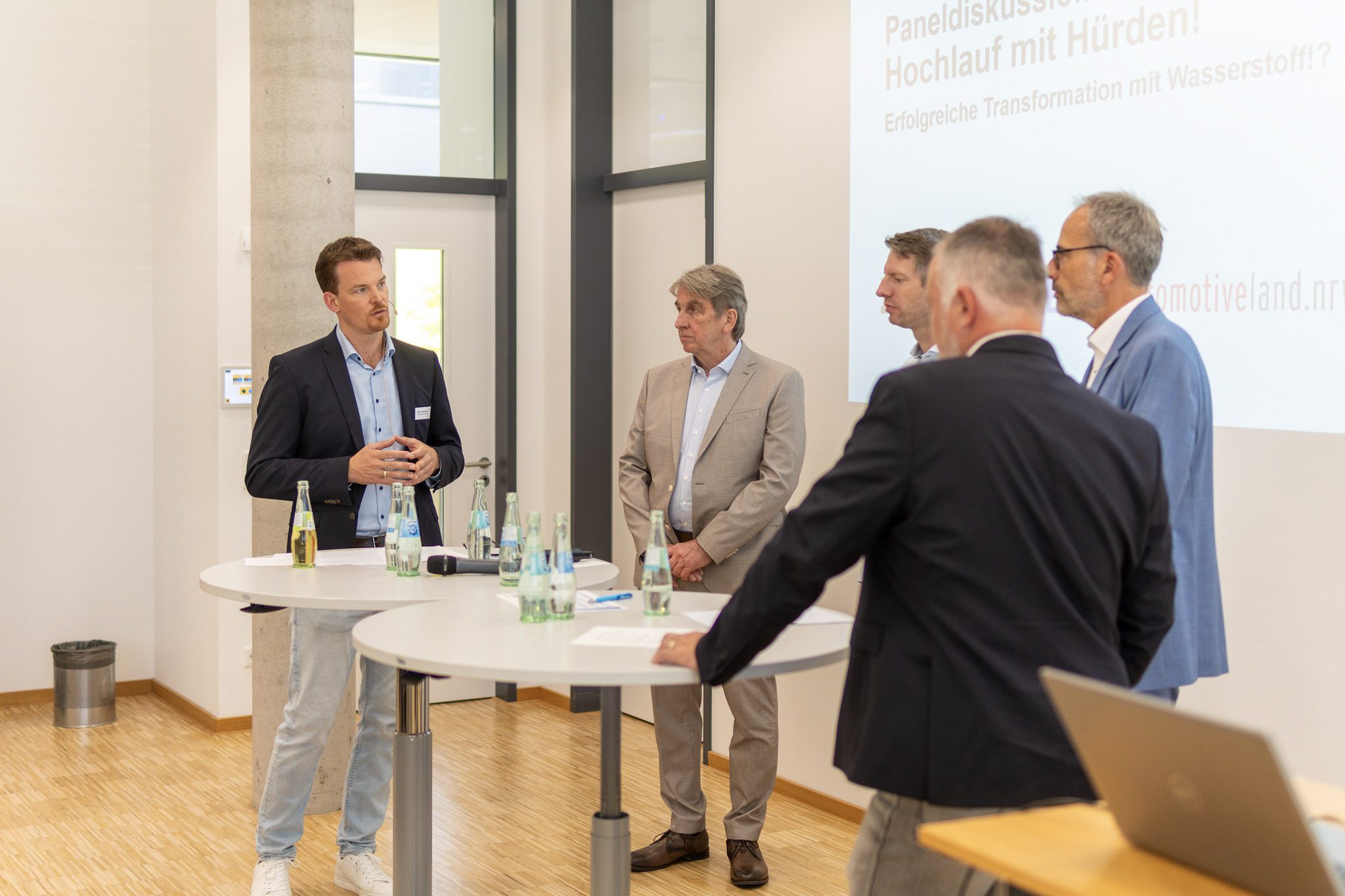
The delegation trip focused on key questions relating to the successful establishment of a hydrogen economy: How can existing expertise from the automotive industry be usefully transferred to hydrogen technologies? What opportunities are there for small and medium-sized enterprises (SMEs) in particular to position themselves in this future-oriented field? And last but not least: What political and economic conditions are necessary for the market ramp-up of hydrogen technologies to be successful in the long term?
High-level professional exchange
The innovation roundtable offered a mix of expert presentations, panel discussions, and live insights into practical applications. Topics discussed included:
- Strategies for industrial H₂ applications (Wilhelm Hannibal, ibh)
- Market prospects and regulatory conditions for hydrogen mobility (Florian Brandau, Clean Energy Partnership e.V.)
- Technological developments and scaling issues (Ulrich Misz, Center for Fuel Cell Technology (ZBT))
- Technological developments and scaling issues (Ulrich Misz, Center for Fuel Cell Technology (ZBT))
A particular highlight was the tour of the Filtration TechCenter. Innovative components such as ion exchangers, cathode air filters, and CCU filtration were presented live—impressive proof of how companies are applying their existing expertise specifically to hydrogen systems.
Hydrogen as the key to decarbonization
A key conclusion: Hydrogen technologies are an important building block for decarbonization—both in the mobility sector and in industrial applications.
However, for the market ramp-up to succeed, clear regulatory guidelines, technological standards, and a sustainable infrastructure are needed.
The field of electrolysis is currently undergoing particularly dynamic development, with decentralized solutions increasingly coming into focus alongside large-scale plants. International funding examples—such as the Dutch SWIM program—show how targeted support can accelerate market ramp-up.
Networks as a factor for success
The event once again underscored how important it is to connect stakeholders along the entire value chain. With the cH₂ance hub, a strong network has emerged in recent years—around 90% of the participants in the innovation round came from industry.
A big thank you goes to all contributors as well as the team at Hengst Filtration, the Center for Fuel Cell Technology (ZBT), and the cH₂ance transformation hub for their excellent organization and inspiring ideas.
Impressions of the event
(Photos: Simon Wierzba / Bergische Gesellschaft)
 English
  Deutsch